
Prime Minister Narendra Modi on Tuesday said Australia will not be at the periphery of India's vision but at the centre of its thought, as he called for closer bilateral security cooperation and a comprehensive global strategy to tackle the menace of terrorism.
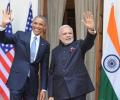
US President Barack Obama's India visit, marked by "high-end symbolism", is a signal to businessmen of both countries to look for opportunities from each other, Mahindra Group Chairman and Managing Director Anand Mahindra has said.

The new equation between 'Namo' and 'Barack' may well 'convert a good start into lasting progress.'

'The Paris Conference is a decisive meeting on climate change.' 'Negotiating an agreement between 196 countries is indeed a challenge.' 'If we go beyond 2°C, the consequences will be extremely difficult to deal with.'The poor are the most vulnerable to the impact of climate change.'
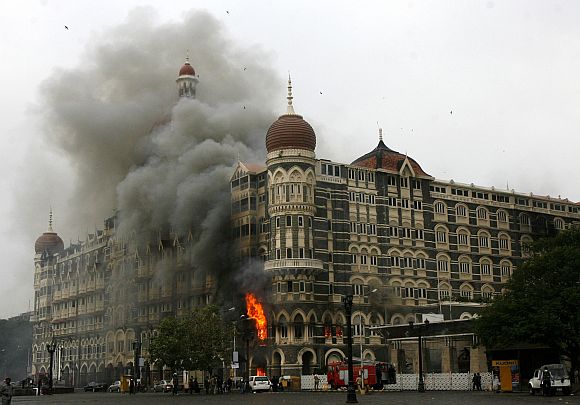
'Headley's testimony indicates to what extent the Pakistan government and its proxies can go to destroy not only Indian scientific talent but also international expertise.'

A government that confuses PowerPoints for policy is delaying structural change too much.

Days before Narendra Modi arrives in the US to speak at the UN, meet Barack Obama, gupshup with the likes of Nadella, Pichai, Zuckerberg, and address desis in Silicon Valley, his ministers will help set the commercial and strategic tone for the prime minister's visit.

'Both Modi and Xi know that if all that there is to show for Modi's visit -- barely eight months after Xi's India trip -- is a repeat of the same old declarations, there will be a terrible sense of letdown in the public mood resulting in future summits losing credibility. Only the possibility of new ground being broken can justify Modi's trip at this time,' says B S Raghavan.

'India alone cannot walk the path of peace. It also has to be Pakistan's journey to make,' says Prime Minister Narendra Modi at the government's geo-political flagship initiative "Raisina Dialogue-II".
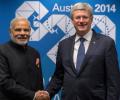
'Notwithstanding the physical distance, the two countries historically had a convergence of approach and outlook to many international issues.' 'The relationship between the two countries cannot develop or flourish in a vacuum. There should be initiatives at various levels -- at the level of government, Parliament and the people.'

This is the joint statement issued by the ministry of external affairs on the visit of US President Barack Obama to India.

PM Modi seems to be gradually ending India's strategic ambiguity
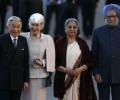
In recent years India-Japan relations have acquired rich economic content and strategic intents. Although the bilateral trade at $18 billion between the two countries is not very impressive and leaves much to be desired, the economic engagement between the two countries is both qualitatively and quantitatively noteworthy. India-Japan defence cooperation, however, has generated a lot interest among the strategic community in the context of rise of China. There has been a lot of speculation about India-Japan strategic partnership to hedge China, says Rup Narayan Das.
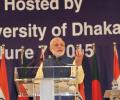
In a blunt attack on Pakistan, Prime Minister Narendra Modi on Sunday accused it of creating "nuisance" and "constantly" troubling India by promoting terrorism.

'The book has immense value because it reveals the inner workings of the think-tank which appears to provide facts and insights to Modi, though he himself takes the final decisions and articulates them in his characteristic rhetorical style,' says Ambassador T P Sreenivasan.

Because of the treaty, no big dams or power projects can be built by India on Jhelum, Indus or Chenab.

Amid souring ties, the president visited Beijing for three days. On his return to India, a hope of better ties has arisen, says senior correspondent R Rajagopalan, who travelled with Pranab Mukherjee to the Asian superpower.

Modi also made a call for European Union unity and said India would play a positive role in enhancing that through Germany.

With Beijing having had a profound rethink on India's admission as a full member of the Shanghai Cooperation Organisation, the tectonic plates of the geopolitics of a massive swathe of the planet stretching from the Asia-Pacific to West Asia are dramatically shifting. That grating noise in the Central Asian steppes will be heard far and wide -- as far as North America, says Ambassador M K Bhadrakumar.
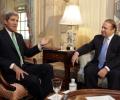
Pakistan Prime Minister Nawaz Sharif continues his exhortation for US mediation in Kashmir, and harks back to his meeting with former Prime Minister Atal Bihari Vajpayee when the latter had agreed to a resolution of Kashmir imbroglio; senior us officials assert there is 'absolutely no change in us policy' that Kashmir has to be resolved bilaterally. Aziz Haniffa reports.

Here's the full text of Prime Minister Narendra Modi's address to the United States Congress.

India hopes to bridge gap with US to buffer against a Paris agreement that restricts country's developmental space.

Modi is the first foreign leader to be invited to the palace by the Crown Prince, who appreciated the role played by Indian workers in the development of UAE as a modern nation, ministry of external affairs spokesperson Raveesh Kumar tweeted.

Facing attacks back home over the issue of intolerance, Prime Minister Narendra Modi on Friday said India's diversity was the country's "strength and pride" and underlined the importance of peaceful co-existence.

'Devyani -- she is a public servant and her personal life has already received far too much attention -- and her ambitious father now need to retreat to the background so that wiser diplomatic heads restore sanity to India-US relations as India prepares for parliamentary elections,' says Ambassador K C Singh.
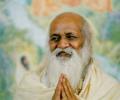
Ramdev's Patanjali is a low-cost, low-margin business that gets away with pretty much what it wants because wily old Ramdev knows how to get around all politicians, says Vir Sanghvi.

'The past year has yielded extraordinary results in the strategic, commercial, and people-to-people components of the India-United States partnership, US Ambassador to India Richard Rahul Verma tells Aziz Haniffa/Rediff.com in an exclusive interview.

'We have a common way of looking at the world, a common way of thinking, and a common set of values that predispose us to be partners. And our interests overlap greatly,' Dr Ashton B Carter, America's next defence secretary, told Aziz Haniffa/Rediff.com in an exclusive interview.

The success of Anil Ambani's ambitious defence plan will depend partly on whether he can persuade government officials and international partners that he can build sophisticated equipment and partly on whether the PM can get India's notoriously slow procurement process to work, say Paritosh Bansal, Sanjeev Miglani and Promit Mukherjee.

Russian firms expand their footprint in India. And take bigger steps to do business with India's private sector.

Prime Minister Narendra Modi's visit to Myanmar is aimed at transforming the arch of Bay of Bengal into the Circle of Southeast Asia, says Anirban Ganguly.
'The Modi-Xi and Modi-Obama meetings, with an interval of just 12 days, are juxtaposed superbly at a crucial point in the prime minister's life. Can Modi carve out a win-win situation with the superpower and the emerging superpower at the same time?'

'We are encouraged by what the prime minister said recently on these issues... We will keep a close eye on these issues. They are very important and as are other elements of our human rights and religious freedom.' 'So, absolutely, we'll keep a focus on them.'

The prime minister made the reference about the functioning of the Parliament against the backdrop of the virtual washout of its Monsoon session over various issues.

'By lifting his visit to vibrant new functional and emotional planes, Modi saved it from looking like a mere obligatory give-and-take. This is no mean achievement. With his penchant for execution, he must fast track action on the proposals agreed upon, so that the fine print matches the hype,' says B S Raghavan.

Silicon Valley can be replicated, but this will only be achieved so long as fresh talent is welcomed by both our countries - a move that will surely spark a billion ideas and discoveries.

Do Modi's foreign visits actually serve India or they nothing more than expensive tools for domestic positioning and image-building, asks Shehzad Poonawalla.

News of all that's transpired on and off the football field

Read the full transcript of President Obama's State of the Union address on Wednesday at the US Capitol in Washington.
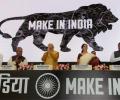
'India is going to maintain its ties to China, India is going to develop a strong relationship with the United States. It means that India is going to have the flexibility to pick and choose its friends.' 'That's traditional Indian foreign policy, and it's smart.' Former US ambassador to India Frank Wisner, one of America's sharpest minds on South Asia, tells Aziz Haniffa/Rediff.com what Washington can expect from Narendra Modi's visit.
 © 2026 Rediff.com - Advertise with us - Disclaimer - Privacy Policy - Sitemap - Feedback - About us - Terms of use - Grievances